What an ingrown toenail actually is
An ingrown toenail is not the whole nail growing into the toe. It is one edge of the nail plate pressing into the wall of skin beside it, and in time piercing it.
Either side of the nail there is a narrow groove, called the sulcus, and a wall of skin standing over that groove, called the nail fold. In a toe that is behaving itself, the nail edge sits in the groove and touches nothing. In an ingrown toenail the edge is too curved, or too short at the corner, or pushed sideways by a shoe, and it presses into the wall of the fold instead.
That is why the pain is so specific. It is at the side of the toe, in a spot you can put a fingertip on, and it is nearly always one edge of one nail. The big toe accounts for most of them, and the outside edge more often than the inside.
The medical name is onychocryptosis, from the Greek for nail and for hidden. The hidden part is the whole problem: the section of nail causing the trouble is usually the part you cannot see.
What it looks like, stage by stage
Ingrown toenails move through recognisable stages, and working out which one you are looking at matters more than the name, because it is the stage that decides what happens next.
Nothing to see yet. The toe looks entirely normal. Press the skin at one side of the nail and it is tender in a way the other side is not. This is the stage that is easiest to deal with and the stage almost nobody acts on.
Early. A thin line of pink or deeper colour runs along one side of the nail. The skin there is slightly puffy, so the nail edge starts to look sunken rather than sitting on the surface. It hurts in anything with a narrow toe box, and it hurts when you catch it on a duvet.
Established. The fold swells and rounds over the nail, so the corner of the nail disappears underneath it. The skin looks tight and shiny and the normal crease beside the nail is lost. There may be clear or straw-coloured fluid. It is sore to any pressure, and often sore to none.
Infected. Now there is thick white, yellow or green discharge rather than clear fluid, the area feels warm, and the redness spreads beyond the immediate nail fold. Throbbing that keeps you awake belongs here.
Longstanding. A lump of soft red tissue sits over the nail edge and bleeds easily whenever it is caught. This is granulation tissue, sometimes called proud flesh. It looks alarming and is not dangerous in itself. It is what the body does when it cannot expel something, and it settles once the nail edge is dealt with.
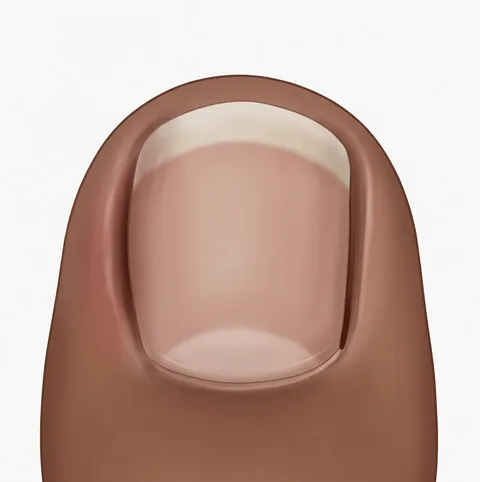
Early
Redness and slight swelling along one side of the nail, with no discharge. The easiest stage to treat, and the one most people wait through.
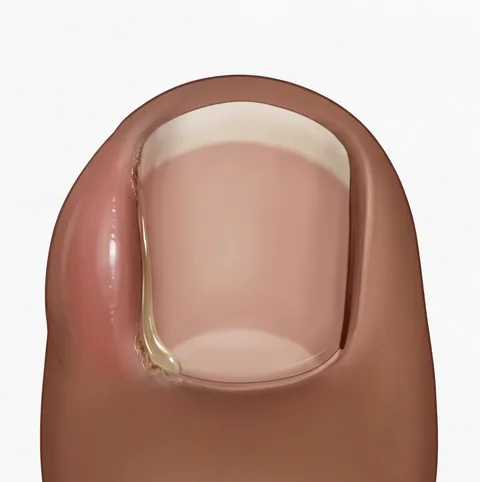
Established
The nail fold is swollen and shiny, and clear or straw-coloured fluid collects in the groove beside the nail.
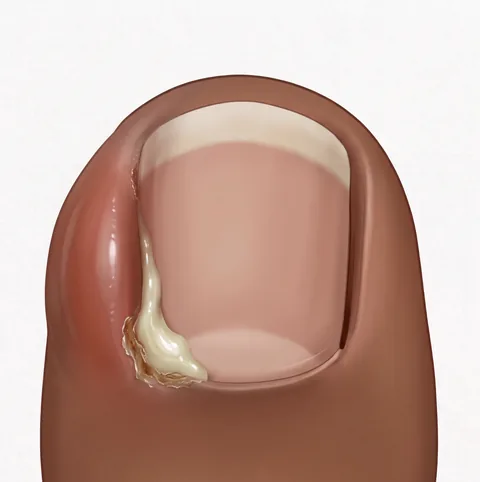
Infected
Thick white or yellow pus discharges from the groove, and the redness spreads beyond the immediate nail fold.
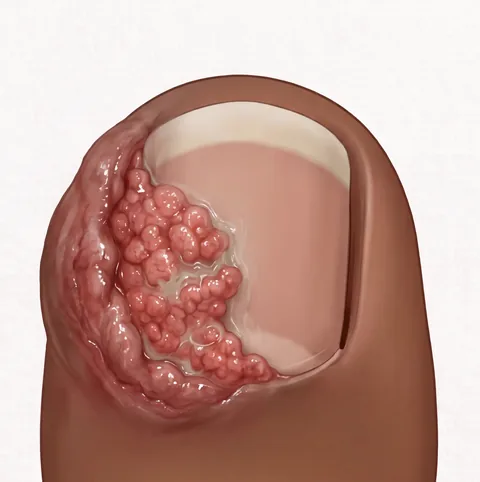
Longstanding
Soft, moist tissue grows out of the fold and over the edge of the nail, and the whole side wall thickens. It looks alarming and settles once the nail edge is dealt with.
Three questions that narrow it down
You cannot diagnose your own toe from an article, and this one is not trying to. What you can do is work out whether an ingrown toenail is the likely explanation or whether it is probably something else, which is worth knowing before you buy anything or decide to wait it out.
Where exactly is the pain? Run a fingertip along the side of the nail, then along the top of the nail, then over the joint at the base of the toe. An ingrown toenail hurts in the groove at the side. Pain under the nail plate points to an injury. Pain in the joint itself points away from the nail entirely.
Can you still see the corner of the nail? If the fold has grown over it, the edge is already through the skin, and the toe is past the stage where anything applied on top of the nail can reach the problem.
Is it one toe, and one side of it? Ingrown toenails are almost always a single edge of a single nail. Several toes at once, or a toe that is uniformly swollen all the way round, suggests a different cause.
If all three answers point the same way, an ingrown toenail is the likely explanation. If they do not, the list below is where to look next.
Six things that get mistaken for it
A fungal nail infection. Fungus lives in the nail plate itself, not in the skin beside it. A fungal nail thickens, turns white, yellow or brown, usually starting at the free edge and working back, and crumbles when it is cut. It is rarely painful at the side. The two get confused, and they also genuinely coincide, because a thickened fungal nail is much harder to cut properly, and that is one of the ways an edge ends up ingrown in the first place.
An infected nail fold. Paronychia is an infection of the skin fold itself, and it can happen with no ingrown edge at all, often after a torn hangnail or picking at the side of the nail. The whole fold goes puffy, tight and shiny, and pus tends to gather in the fold rather than tracking down beside the nail. The overlap is real, because an ingrown edge is one of the common causes of one. The reason the distinction matters: treating the infection without dealing with a nail edge underneath buys a few weeks and no more.
Gout. Gout attacks the joint, not the nail. It usually hits the joint at the base of the big toe, comes on suddenly and often overnight, and the whole joint is hot, red and swollen to the point where the weight of a bedsheet is unbearable. The nail edge itself looks normal. If the pain is in the joint rather than at the nail, that is one for a GP.
A blister or a corn. Both are skin problems caused by rubbing, and both turn up at the side of the toe, which is exactly where an ingrown nail would be. A blister is a fluid-filled bubble sitting on the surface. A corn is a hard, thickened plug of skin with a dense centre, and a soft corn between the toes goes white and soggy. Neither is attached to the nail edge, and pressing the nail does not reproduce the pain.
A bruised nail. Blood trapped under the nail plate, a subungual haematoma, follows a stub, a dropped object, or sustained pressure from tight shoes, and running downhill is a classic cause. It shows as dark red, purple or black under the nail, and the pain is a deep throb that is worse when you press on top of the nail rather than at the side.
A nail that is simply very curved. Some nails are strongly over-curved from the start, described as involuted or, at the extreme, a pincer nail. The edges roll down into the sulcus and the toe feels tight and tender, but the skin has never been pierced. It is uncomfortable and it is a real risk factor for the genuine article, but it is not the same thing and it does not need the same treatment.
Why pictures online are the least reliable check
Searching for pictures is the most common way people try to settle this, and it is the method most likely to mislead. Three reasons.
The photographs are skewed towards the dramatic end. Advanced, infected and granulating toes are what get photographed and published, because they are visually unmistakable. The early stage, which is the one worth catching, barely photographs at all. So a toe at the stage where a few minutes of work would sort it looks nothing like the search results, and people conclude they must be fine.
Colour is unreliable. Redness reads completely differently across skin tones. On darker skin an inflamed nail fold often looks purple, brown, or simply darker and shinier than the skin around it rather than red, and the photographs circulating online are heavily weighted towards lighter skin. Swelling, shine, warmth and the loss of the normal crease beside the nail are all more dependable than colour.
And no photograph, including your own, shows the thing that decides the treatment: whether a spike of nail has broken off and stayed buried under the fold. That is out of sight by definition. It is also the single most common reason a toe carries on hurting after someone believes they have dealt with it.
A photograph is still worth taking. It is just worth sending to someone who knows what they are looking at, rather than matching against a gallery. Send a photo of your own toe and Anna will tell you what it needs.
When it stops being a question of which one it is
Most of the toes described here can wait for an ordinary appointment. A few cannot, and the line is drawn by how you feel rather than by how the toe looks.
If you feel unwell in yourself, if you have a fever or chills, or if redness is spreading up the foot or tracking as streaks up the leg, that needs urgent medical attention the same day. Those are signs that an infection is no longer confined to the toe, and at that point it has stopped being a podiatry question.
Separately, if you have diabetes, poor circulation, reduced feeling in your feet, or a condition or medication that suppresses your immune system, do not work through checklists at home. Have the toe looked at. The margin for error is much smaller, and the early stages can be almost painless, which removes the warning you would otherwise get.
Short of either of those, a toe that is discharging pus, or one you cannot get a shoe onto, needs an appointment soon rather than watching.
What happens once you know
If the skin is unbroken and there is no discharge, this is a mild ingrown toenail, and conservative treatment is entirely reasonable. What genuinely helps and what to stop doing is set out in the treatment guide.
If the edge is already through the skin, the edge itself has to be dealt with, and it cannot be reached from above. In clinic the toe is numbed first, so the part people dread turns out to be the part that does not hurt. Often the relief is immediate, and comes simply from removing a buried spike that was never going to work its own way out.
If it keeps coming back, the answer is a partial nail avulsion with phenol. The problem strip of nail edge is removed and the small area of nail bed that produced it is treated so it does not grow back. The rest of the nail is left alone, and the toe looks normal afterwards.
And if you have read all of this and still are not sure, that is a perfectly reasonable place to end up. Plenty of toes do not read the textbook. That is what a photo assessment is for.